
FAQ sections used to be an easy SEO win: add a few questions, mark them up, and Google showed them as expandable rich results under your listing. That era is over. Google limited FAQ rich results to government and health sites in August 2023 and stopped showing them entirely on May 7, 2026.
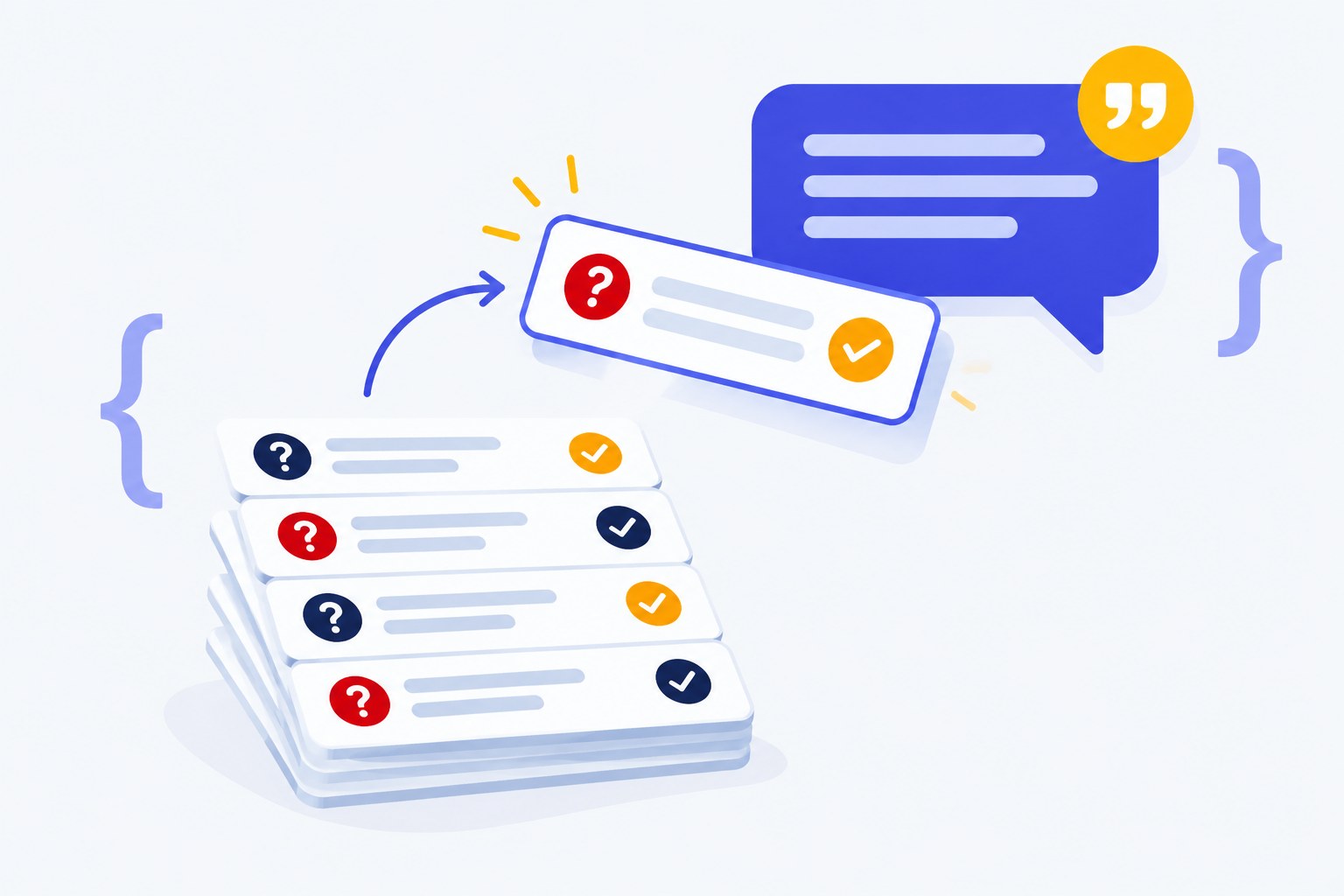
Yet well-written FAQ content is more useful than ever, because it has the exact shape AI assistants look for: a question someone actually asks, followed by a short answer that makes sense on its own. ChatGPT, Perplexity, Claude and Google's AI Overviews build answers from passages like that. This guide covers how to write FAQ content that AI systems can lift and cite, where schema still helps (and where it doesn't), and the mistakes that make good answers invisible.
Why FAQ Content Still Matters When the Rich Results Are Gone
AI search doesn't rank pages the way a results page does — it retrieves passages. When someone asks a question, the system pulls candidate pages, picks the fragments that answer the question best, and writes a response that cites some of them. A good FAQ is a stack of ready-made fragments: each one has a clear question, a direct answer and no dependency on the paragraph before it.
Three findings shape how to write for that:
- Citations are no longer reserved for the top ten. In Ahrefs' March 2026 study of 863,000 search results, only about 38% of URLs cited in AI Overviews also ranked in the organic top 10 — down from about 76% in the same team's 2025 study. A precise answer on a page that ranks 15th can still be quoted.
- Evidence beats polish. The original GEO research from Princeton and partners (KDD 2024) found that adding statistics, quotations and cited sources raised a page's visibility in generative answers by roughly 30–40%, while keyword stuffing did worse than doing nothing.
- Questions to AI are longer and more specific. A Semrush study of 80 million clickstream records found ChatGPT prompts without search averaged 23 words, compared with about 4 words for prompts that triggered a search. People ask complete questions — so your FAQ should answer complete questions.
Step 1: Choose Questions People Actually Ask
The most common FAQ failure happens before anyone writes an answer: the questions are invented by the marketing team. "Why choose us?" and "What makes our service unique?" are not queries anyone types into ChatGPT, so no AI answer will ever need them.
Build the list from real demand instead:
- Google Search Console — filter Queries for words like how, what, why, can, does and vs; these are questions you already get impressions for
- "People also ask" boxes for your main topics
- Support tickets, sales calls and pre-sale emails — the questions customers ask in their own words
- Reddit, forums and Quora threads in your niche, which AI engines also read
- AI assistants themselves — ask ChatGPT or Perplexity about your topic and note the follow-up questions they suggest
Keep each FAQ to one topic and five to eight questions. A page that answers everything answers nothing well, and the same generic FAQ pasted on fifty pages is duplicate content for search engines and AI alike.
Step 2: Write Answer-First
An AI system quoting your page lifts a sentence or two, not the whole section. So the first sentence after each question must work on its own: it should answer the question completely, name the subject instead of saying "it", and contain the key fact. Context, caveats and examples come after.
Compare two answers to "How long does a 301 redirect take to pass rankings?":
Context-first (hard to quote): "There are many factors to consider here, and every site is different. In our experience it depends on crawl frequency, which in turn depends on several things…"
Answer-first (quotable): "A 301 redirect starts passing signals as soon as Google recrawls the old URL, which usually takes days to a few weeks on an active site. You can speed it up by submitting the new URL in Search Console and keeping the redirect in place for at least a year."
A practical template for every answer:
- Direct answer in 40–60 words that stands alone
- One supporting fact — a number, a date, a named source
- Detail or example in a short list or a sentence or two
- Link to the deeper guide when the topic needs one
Use the question exactly as people phrase it for the heading, and mark it up as a real heading (H3 under an "FAQ" H2 works well). Keep paragraphs short. A heading such as "The Timeline for Structured Data Rollout" is creative; "How Long Does Schema Take to Show Up?" is retrievable.
Step 3: Back Answers With Evidence
Facts with sources give AI systems something specific to quote and a reason to trust it. Attribute data in the sentence itself — "According to Google's documentation…", "In Ahrefs' 2026 study…" — rather than in a footnote, and link to the original source, not to a blog that summarized it.
A word of caution, because this is where many AI-optimization articles go wrong: use only numbers you can trace. Popular "GEO statistics" are often recycled from unnamed studies or vendors with no published method. An AI system that cross-checks a figure and can't find it elsewhere has no reason to repeat it — and a reader who checks it has no reason to trust you again.
Trust signals around the FAQ matter too. Put a named author with a short bio on the page, show the publication and last-updated dates, and link the author to an about page. These are the same E-E-A-T signals Google has asked for since long before AI answers existed.
Step 4: Add FAQPage Schema — and Keep Your Expectations Realistic
FAQPage markup no longer earns a rich result in Google, but it is still valid schema.org, still read by other search engines and parsers, and it labels each question and answer unambiguously. It costs nothing to keep. A correct minimal example:
<script type="application/ld+json">
{
  "@context": "https://schema.org",
  "@type": "FAQPage",
  "mainEntity": [
    {
      "@type": "Question",
      "name": "Does FAQPage schema still work in 2026?",
      "acceptedAnswer": {
        "@type": "Answer",
        "text": "FAQPage is still valid schema.org markup, but Google stopped showing FAQ rich results on May 7, 2026."
      }
    }
  ]
}
</script>
Three rules keep it clean:
- Mark up only what's visible. Every question and answer in the JSON-LD must appear on the page with the same wording.
- One FAQPage per page, listing all of its questions.
- No invented properties. Some templates add fields like
answerRating— schema.org's Answer type has no such property, and validators will flag it.
What schema won't do is make a weak answer citable. When Ahrefs compared 1,885 pages that added JSON-LD with similar pages that didn't, it found essentially no lift in AI citations. Treat markup as hygiene that makes good content easier to parse, not as a lever on its own — the writing does the work.
Step 5: Make Sure Crawlers Can Read the Answers
Accordions are fine. Google's spam policies explicitly list accordion and tabbed content as a design that does not violate them, so you don't have to give up a compact layout. What matters is where the text comes from:
- Answers in the HTML — including inside
<details>elements or CSS-collapsed panels — are read by every crawler. - Answers loaded on click through JavaScript or AJAX are a problem. Google's mobile-first guidance warns against lazy-loading primary content on user interaction, and most AI crawlers don't execute JavaScript at all.
The check takes a minute: open the page, choose View Page Source, and search for the text of an answer. If it's not there, neither AI search nor your schema validator sees it. And make sure the bots themselves are allowed in — our AI crawler guide shows how to confirm that OAI-SearchBot, PerplexityBot and Claude-SearchBot get a 200 rather than a 403.
Common FAQ Mistakes That Block Citations
| Mistake | Warning sign | Fix |
|---|---|---|
| Promotional questions | No one searches the question | Replace with questions from Search Console, support and forums |
| Vague answers | No number, date, name or concrete step | Lead with the specific fact; cut the warm-up |
| Answers that need context | First sentence starts with "It", "This" or "As mentioned" | Name the subject; make the sentence stand alone |
| Schema that doesn't match the page | JSON-LD questions differ from visible text, or answers are hidden | Generate schema from the visible FAQ, never separately |
| One FAQ copied everywhere | Identical questions on dozens of URLs | Write a topic-specific FAQ per page |
| JavaScript-loaded answers | Answer text missing from page source | Render answers in the HTML; collapse with CSS or <details> |
| Stale facts | Prices, versions or dates from last year | Review FAQs on a schedule and update the modified date honestly |
How Long Should FAQ Answers Be?
No credible study pins down a magic word count, so optimize for the reader and the quote. Practical ranges that work well:
- Direct answer: 40–60 words — long enough to be complete, short enough to be quoted whole
- Full answer: 50–150 words; if it needs more, it probably deserves its own section or article with a link from the FAQ
- Questions per FAQ: 5–8 on an article or service page; 4–6 on a product page
- Paragraphs: two or three sentences each
Building FAQ Content in WordPress
A clean FAQ needs three things in WordPress: visible question-and-answer blocks, matching FAQPage markup, and someone checking that both stay in sync.
- Write it as normal content. In the block editor, an H2 "Frequently Asked Questions" followed by an H3 per question and a paragraph per answer gives you crawlable, accessible HTML with no plugin at all.
- Add the markup. The free SEO Fury plugin includes FAQ among its 20+ schema types, so you can attach FAQPage markup to any post without code.
- Draft faster with PRO. SEO Fury PRO's AI FAQ generator reads the article and drafts five questions readers are likely to ask, inserts them into the post as real H2/H3 and paragraph blocks, and enables FAQPage schema for that post — so the markup always matches what's on the page. Review and edit the answers before you publish; the AI drafts, you stay the expert.
- Check citability while you write. PRO's GEO score panel in the editor checks eight signals while you write — a direct answer near the top, a definition sentence, question-style subheadings, quotable paragraph length, lists or tables, numeric facts, an FAQ section and cited sources — and says what to fix for each one that fails.
- WooCommerce. PRO's Product FAQ adds a shop-authored FAQ tab to product pages and outputs FAQPage markup only while that tab is visible.
Measuring Whether Your FAQs Get Cited
There is no Search Console report for AI citations, so combine a few signals:
- Manual prompt checks. Once a month, ask ChatGPT, Perplexity and Google (AI Mode) your top ten FAQ questions and record whether your page is cited.
- AI fetches. User-triggered fetchers such as ChatGPT-User and Perplexity-User request a page when an assistant reads it for someone; a rising count on an FAQ page is a good sign.
- AI referral visits. Sessions from chatgpt.com, perplexity.ai, claude.ai and gemini.google.com, by landing page.
- Search Console queries. Growth in long, question-style queries for the page usually comes with better AI visibility too.
Then iterate: rewrite the first sentence of answers that never get cited, add a sourced fact, and replace questions nobody asks. For the bigger picture of AI visibility on WordPress, see our GEO for WordPress guide.
Frequently Asked Questions
Does FAQPage schema still work in 2026?
FAQPage is still valid schema.org markup that search engines and AI systems can parse, but Google stopped showing FAQ rich results on May 7, 2026. Keep the markup on pages with a visible FAQ, and don't expect it to raise AI citations by itself — the quality of the answers does that.
How long should an FAQ answer be for AI citations?
Start each answer with a 40–60 word sentence or two that fully answers the question on its own, then add supporting detail. Most answers fit in 50–150 words; anything longer usually deserves its own section or article.
Are FAQ accordions bad for SEO or AI search?
No. Google's spam policies list accordions and tabs as acceptable design. The answer text just needs to be in the page's HTML from the start, not loaded by JavaScript when someone clicks, because most AI crawlers don't run JavaScript.
Where should FAQ questions come from?
From real demand: question-style queries in Google Search Console, "People also ask" boxes, support tickets, sales calls and forum threads in your niche. Questions written only to promote the business are rarely asked and rarely cited.
Do AI Overviews only cite pages in Google's top 10?
No. Ahrefs' March 2026 study found that only about 38% of URLs cited in AI Overviews also ranked in the organic top 10, so a precise, well-structured answer on a lower-ranking page can still be quoted.
Try SEO Fury Free
50+ SEO features, unlimited sites, no credit card. Install it and score your first post in under five minutes.
Get SEO Fury Free